Let's face it, this has been one of the most intriguing offseasons in recent memory. There have been many interesting storylines playing out in front of the backdrop of a worldwide recession. Now, essentially one week from pitchers and catchers reporting to spring training, there are still several significant free agents on the market. Let's take a look at where they are most likely to end up:
Orlando Cabrera
Cabrera is a decent defensive shortstop with some talent at the plate. He is definitely in decline. He is still of some value, but most likely much less than the $7 mil per he had been looking for.
Most likely suitors:
Atlanta Braves
Oakland Athletics
Atlanta could find a way to fit Cabrera in, but it might not be worth dealing Escobar. Oakland would only be in if the price were right.
Best fit:
Oakland
Juan Cruz
Cruz is a very solid reviever. His biggest issue this offseason has not been lack of talent or teams that could use his services, it is his Type A free agent status. While Cruz certainly pitched like a Type A last year, teams are not willing to give up a first round draft pick, who will have a solid chance of surpassing Cruz 3 years down the road, for a solid reliever who might only help for a season or two.
Most likely suitors:
New York Yankees
Detroit Tigers
The Yankees would be a good fit, but have shown limited interest. The fact that the Yankees wouldn't have as much concern about the draft pick seems to link their name to Cabrera's. Very unlikely the Tigers would make this move, due to the draft pick.
Best fit:
Minnesota Twins
Bobby Abreu
Once said to be looking for a 4 year $56 million deal, Abreu is now anxiously seeking a one-year deal in perhaps the $7 million range. Sadly, Abreu may have to come down even farther to gain serious interest.
Most likely suitors:
Atlanta Braves
Chicago White Sox
Los Angeles Dodgers
The Braves are in desperate need of an outfield bat, but after the acquisition of Lowe, Vazquez, etc. it remains to be seen if they have anymore financial flexibility. The White Sox would most likely have to find a suitor for Jermaine Dye before seriously considering Abreu. This seems unlikely since Dye is vastly overpriced relative to the market. The Dodgers' interest seems to be limited to calling Manny's bluff.
Best fit:
Atlanta Braves
Orlando Hudson
Solid talent, with a couple of strong years ahead of him. Some freak injuries seem to hurt his already sagging market.
Most likely suitors:
Washington Nationals
Los Angeles Dodgers
New York Mets
The Nationals seem interested, but are being very patient looking for a bargain. The Dodgers will only sign Hudson if they miss out on Ramirez or there is an even greater drop in price. The Mets could only make a move if Omar Minaya pulled off a miracle and moved Luis Castillo.
Best fit:
Washington Nationals
Adam Dunn
A controversial figure: despised by traditionalists, embraced by statistical analysts. Dunn could make almost any lineup better, he could also make almost any outfield defense worse. The upside is greater than the downside, but he is still struggling to find a real market.
Most likely suitors:
Washington Nationals
Atlanta Braves
The Nationals will make a move if no one else does. They would be ecstatic if both Hudson and Dunn fell into their laps at an affordable price. The Braves could use his bat, but seem very wary of the Ks and the defense.
Best fit:
New York Mets
Manny Ramirez
Unbelievable talent. Future first ballot hall of famer. Great entertainer. Clutch Hitter. Poor financial decision maker.
Most likely suitors:
Los Angeles Dodgers
San Francisco Giants
The baseball world would be collectively shocked if Manny didn't sign with the Dodgers.
Best fit:
New York Mets
Showing posts with label Bobby Abreu. Show all posts
Showing posts with label Bobby Abreu. Show all posts
06 February, 2009


20 January, 2009
Clock Ticking on Free Agent Outfielders
There are three difference-making outfielders left on the free agent market. Manny Ramirez is far and away the greatest of the three, but of the remaining two, Adam Dunn and Bobby Abreu, who would be the better acquisition? Let's take an in-depth look at these two outfielders.
Let's start off by looking at how each of Bobby Abreu and Adam Dunn stack up in the categories of the five basic tools: hitting for average, hitting for power, running, throwing, and fielding.
Hitting for Average:
Abreu
1998 - .312 in 497 at-bats
1999 - .335, 546 ab
2000 - .316, 576 ab
2001 - .289, 588 ab
2002 - .308, 572 ab
2003 - .300, 577 ab
2004 - .301, 574 ab
2005 - .286, 588 ab
2006 - .297, 548 ab
2007 - .283, 605 ab
2008 - .296, 609 ab

Dunn
2001 - .262 in 244 at-bats
2002 - .249, 535 ab
2003 - .215, 381 ab
2004 - .266, 568 ab
2005 - .247, 543 ab
2006 - .234, 561 ab
2007 - .264, 522 ab
2008 - .236, 517 ab
Abreu is by far the greater hitter for average.
Hitting for Power:
Abreu
1998 - .497 SLG, 17 HR
1999 - .549, 20 HR
2000 - .554, 25 HR
2001 - .543, 31 HR
2002 - .521, 20 HR
2003 - .468, 20 HR
2004 - .544, 30 HR
2005 - .474, 24 HR
2006 - .462, 15 HR
2007 - .445, 16 HR
2008 - .471, 20 HR
Dunn
2001 - .578 SLG, 19 HR
2002 - .454, 26 HR
2003 - .465, 27 HR
2004 - .569, 46 HR
2005 - .540, 40 HR
2006 - .490, 40 HR
2007 - .554, 40 HR
2008 - .513, 40 HR
To emphasize how big of a landslide this is for Dunn let's compare his Isolated Power with Abreu's:
Abreu
1998 - .185
1999 - .214
2000 - .238
2001 - .253
2002 - .213
2003 - .168
2004 - .242
2005 - .189
2006 - .164
2007 - .162
2008 - .176
Dunn
2001- .316
2002 - .206
2003 - .249
2004 - .303
2005 - .293
2006 - .257
2007 - .289
2008 - .277
Abreu's best IsoP season is barely better than Dunn's second worst. There is really no comparison between their power.
Before we leave the subject of hitting there is something that must be addressed when discussing these two players: on-base percentage. Both of the players are phenomenal at drawing walks.
Let's compare the two:
Abreu
1998 - .409 OBP, 14.5 BB%
1999 - .446, 16.6
2000 - .416, 14.8
2001 - .393, 15.3
2002 - .413, 15.4
2003 - .409, 15.9
2004 - .428, 18.1
2005 - .405, 16.6
2006 - .424, 18.5
2007 - .369, 12.2
2008 - .371, 10.7
Dunn
2001 - .371 OBP, 13.5 BB%
2002 - .400, 19.3
2003 - .354, 16.3
2004 - .388, 16.0
2005 - .387, 17.4
2006 - .365, 16.6
2007 - .386, 16.2
2008 - .386, 19.1
Abreu's average has already been accounted for and we know that it is far superior to Dunn's. We include BB% here to illustrate that both players are extremely talented in the art of drawing a walk. Excluding average from the inflation of the OBP these players are roughly even with Adam Dunn having a slight edge in the ability to get on-base aside from hits.
Running:
Abreu
1998 - 19 SB
1999 - 27 SB
2000 - 28 SB
2001 - 36 SB
2002 - 31 SB
2003 - 22 SB
2004 - 40 SB
2005 - 31 SB, -1.8
2006 - 30 SB, 5.3 EqBRR
2007 - 25 SB, 0.1 EqBRR
2008 - 22 SB, -.6 EqBRR
Dunn
2001 - 4 SB
2002 - 19 SB
2003 - 8 SB
2004 - 6 SB
2005 - 4 SB, -2.6 EqBRR
2006 - 7 SB, -0.8 EqBRR
2007 - 9 SB, 1.6 EqBRR
2008 - 2, -2.6 EqBRR
Surprisingly Bobby Abreu doesn't grab a huge lead here. He is certainly a much bigger threat to steal a base, but looking at Baseball Prospectus's Equivalent Base-running Runs Abreu is not a huge factor on the base paths. He had a great year in 2006, but the last couple of seasons have been about average. He is slightly ahead of Dunn, but not by a monumental amount. It is important to note that the EqBRR is a much better way of measuring a baserunner's worth than stolen bases, because in addition to steals and caught stealing EqBRR takes into account running on hits, sacrifices, and being thrown out in similar situations.
Now when it comes to throwing and fielding for these players both are lackluster. Since there is a dearth of fielding statistics we'll view throwing and fielding collectively through the fielding statistic UZR/150. This takes into account both throwing and fielding so it will be useful to us in our current examination. (We have used accounting notation by reflecting negative values in parantheses).
Throwing and Fielding:
Abreu
2002 - 6.7
2003 - 13.4
2004 - (10.4)
2005 - (6.9)
2006 - (14.8)
2007 - (3.9)
2008 - (25.9)
Dunn
2002 - 1.0
2003 - (4.7)
2004 - (6.6)
2005 - (14.7)
2006 - (11.0)
2007 - (16.3)
2008 - (22.6)
We have only included the statistics accumulated in the outfield since we are valuing them as outfielders. As you can see neither player is a particularly talented defensive outfielder. When Abreu was younger he was able to make up for some of his shortcomings with his speed, but now neither player is effective and is in fact quite a detriment.
Let's take a look at the cumulative value of these players over the past 6 seasons. We will look at their season-by-season VORP and their defensive runs allowed/prevented relative to replacement level:
Abreu
2003 - 43.0 VORP, 0 runs prevented
2004 - 73.5, 2
2005 - 47.1, -17
2006 - 49.0, -3
2007 - 27.9, -2
2008 - 33.2, -6
Dunn
2003 - 10.1, -6
2004 - 53.4, -17
2005 - 45.0, -11
2006 - 23.5, -13
2007 - 45.5, -17
2008 - 36.6, -10
Overall, offensively Adam Dunn is a more productive outfielder. Defensively however, as bad as Abreu is, he's not as bad as Adam Dunn. The offensive upside of Adam Dunn is likely to negate the greater negative that his defense provides, making him a slightly better choice than Bobby Abreu.
Another factor that can easily be seen in these statistics is age. Bobby Abreu is certainly on the downhill side of a very nice career. Adam Dunn is still in his prime years. One alarming statistic is Bobby Abreu's decline in walk percentage, one of his greatest assets throughout his career.
Using baseball age (age as of July 1 of the season in question), Bobby Abreu is 35 while Adam Dunn is only 29. This is huge difference when looking at these two players. If contract considerations are equal a team should look to add Adam Dunn before Bobby Abreu. While Abreu may have a couple more serviceable seasons in him, those seasons will almost certainly be less valuable than Adam Dunn's.
So what are these players worth on the market today? CHONE places Abreu's value at $10.6 million for average defense ($4.8 mil for putrid defense and $7.5 mil for poor defense), and Dunn's value at $12.8 million for average defense ($6.6 mil for putrid defense and $9.7 mil for poor defense).
Using CHONE's values at poor defense (being optimistic) and projecting a slight decline for 2010 and 2011:
Abreu is worth 3/$19 mil with even distribution of payments.
Dunn is worth 3/$26.6 mil with even distribution of payments.
Using our own projections we value them at:
Abreu is worth 3/$22.2 mil with even distribution of payments.
Dunn is worth 3/$27.0 mil with even distribution of payments.
Teams in need of outfield offensive help should strongly consider either Abreu or Dunn, but especially Dunn if the market continues to sag for these two professional hitters.
Let's start off by looking at how each of Bobby Abreu and Adam Dunn stack up in the categories of the five basic tools: hitting for average, hitting for power, running, throwing, and fielding.
Hitting for Average:
Abreu
1998 - .312 in 497 at-bats
1999 - .335, 546 ab
2000 - .316, 576 ab
2001 - .289, 588 ab
2002 - .308, 572 ab
2003 - .300, 577 ab
2004 - .301, 574 ab
2005 - .286, 588 ab
2006 - .297, 548 ab
2007 - .283, 605 ab
2008 - .296, 609 ab

Dunn
2001 - .262 in 244 at-bats
2002 - .249, 535 ab
2003 - .215, 381 ab
2004 - .266, 568 ab
2005 - .247, 543 ab
2006 - .234, 561 ab
2007 - .264, 522 ab
2008 - .236, 517 ab
Abreu is by far the greater hitter for average.
Hitting for Power:
Abreu
1998 - .497 SLG, 17 HR
1999 - .549, 20 HR
2000 - .554, 25 HR
2001 - .543, 31 HR
2002 - .521, 20 HR
2003 - .468, 20 HR
2004 - .544, 30 HR
2005 - .474, 24 HR
2006 - .462, 15 HR
2007 - .445, 16 HR
2008 - .471, 20 HR
Dunn
2001 - .578 SLG, 19 HR
2002 - .454, 26 HR
2003 - .465, 27 HR
2004 - .569, 46 HR
2005 - .540, 40 HR
2006 - .490, 40 HR
2007 - .554, 40 HR
2008 - .513, 40 HR
To emphasize how big of a landslide this is for Dunn let's compare his Isolated Power with Abreu's:
Abreu
1998 - .185
1999 - .214

2000 - .238
2001 - .253
2002 - .213
2003 - .168
2004 - .242
2005 - .189
2006 - .164
2007 - .162
2008 - .176
Dunn
2001- .316
2002 - .206
2003 - .249
2004 - .303
2005 - .293
2006 - .257
2007 - .289
2008 - .277
Abreu's best IsoP season is barely better than Dunn's second worst. There is really no comparison between their power.
Before we leave the subject of hitting there is something that must be addressed when discussing these two players: on-base percentage. Both of the players are phenomenal at drawing walks.
Let's compare the two:
Abreu
1998 - .409 OBP, 14.5 BB%
1999 - .446, 16.6
2000 - .416, 14.8
2001 - .393, 15.3
2002 - .413, 15.4
2003 - .409, 15.9
2004 - .428, 18.1
2005 - .405, 16.6
2006 - .424, 18.5
2007 - .369, 12.2
2008 - .371, 10.7
Dunn
2001 - .371 OBP, 13.5 BB%
2002 - .400, 19.3
2003 - .354, 16.3
2004 - .388, 16.0
2005 - .387, 17.4
2006 - .365, 16.6
2007 - .386, 16.2
2008 - .386, 19.1
Abreu's average has already been accounted for and we know that it is far superior to Dunn's. We include BB% here to illustrate that both players are extremely talented in the art of drawing a walk. Excluding average from the inflation of the OBP these players are roughly even with Adam Dunn having a slight edge in the ability to get on-base aside from hits.
Running:
Abreu
1998 - 19 SB
1999 - 27 SB
2000 - 28 SB
2001 - 36 SB
2002 - 31 SB
2003 - 22 SB
2004 - 40 SB
2005 - 31 SB, -1.8
2006 - 30 SB, 5.3 EqBRR
2007 - 25 SB, 0.1 EqBRR
2008 - 22 SB, -.6 EqBRR
Dunn
2001 - 4 SB
2002 - 19 SB
2003 - 8 SB
2004 - 6 SB
2005 - 4 SB, -2.6 EqBRR
2006 - 7 SB, -0.8 EqBRR
2007 - 9 SB, 1.6 EqBRR
2008 - 2, -2.6 EqBRR
Surprisingly Bobby Abreu doesn't grab a huge lead here. He is certainly a much bigger threat to steal a base, but looking at Baseball Prospectus's Equivalent Base-running Runs Abreu is not a huge factor on the base paths. He had a great year in 2006, but the last couple of seasons have been about average. He is slightly ahead of Dunn, but not by a monumental amount. It is important to note that the EqBRR is a much better way of measuring a baserunner's worth than stolen bases, because in addition to steals and caught stealing EqBRR takes into account running on hits, sacrifices, and being thrown out in similar situations.
Now when it comes to throwing and fielding for these players both are lackluster. Since there is a dearth of fielding statistics we'll view throwing and fielding collectively through the fielding statistic UZR/150. This takes into account both throwing and fielding so it will be useful to us in our current examination. (We have used accounting notation by reflecting negative values in parantheses).
Throwing and Fielding:
Abreu
2002 - 6.7
2003 - 13.4
2004 - (10.4)
2005 - (6.9)
2006 - (14.8)
2007 - (3.9)
2008 - (25.9)
Dunn
2002 - 1.0
2003 - (4.7)
2004 - (6.6)
2005 - (14.7)
2006 - (11.0)
2007 - (16.3)
2008 - (22.6)
We have only included the statistics accumulated in the outfield since we are valuing them as outfielders. As you can see neither player is a particularly talented defensive outfielder. When Abreu was younger he was able to make up for some of his shortcomings with his speed, but now neither player is effective and is in fact quite a detriment.
Let's take a look at the cumulative value of these players over the past 6 seasons. We will look at their season-by-season VORP and their defensive runs allowed/prevented relative to replacement level:
Abreu
2003 - 43.0 VORP, 0 runs prevented
2004 - 73.5, 2
2005 - 47.1, -17
2006 - 49.0, -3
2007 - 27.9, -2
2008 - 33.2, -6
Dunn
2003 - 10.1, -6
2004 - 53.4, -17
2005 - 45.0, -11
2006 - 23.5, -13
2007 - 45.5, -17
2008 - 36.6, -10
Overall, offensively Adam Dunn is a more productive outfielder. Defensively however, as bad as Abreu is, he's not as bad as Adam Dunn. The offensive upside of Adam Dunn is likely to negate the greater negative that his defense provides, making him a slightly better choice than Bobby Abreu.
Another factor that can easily be seen in these statistics is age. Bobby Abreu is certainly on the downhill side of a very nice career. Adam Dunn is still in his prime years. One alarming statistic is Bobby Abreu's decline in walk percentage, one of his greatest assets throughout his career.
Using baseball age (age as of July 1 of the season in question), Bobby Abreu is 35 while Adam Dunn is only 29. This is huge difference when looking at these two players. If contract considerations are equal a team should look to add Adam Dunn before Bobby Abreu. While Abreu may have a couple more serviceable seasons in him, those seasons will almost certainly be less valuable than Adam Dunn's.
So what are these players worth on the market today? CHONE places Abreu's value at $10.6 million for average defense ($4.8 mil for putrid defense and $7.5 mil for poor defense), and Dunn's value at $12.8 million for average defense ($6.6 mil for putrid defense and $9.7 mil for poor defense).
Using CHONE's values at poor defense (being optimistic) and projecting a slight decline for 2010 and 2011:
Abreu is worth 3/$19 mil with even distribution of payments.
Dunn is worth 3/$26.6 mil with even distribution of payments.
Using our own projections we value them at:
Abreu is worth 3/$22.2 mil with even distribution of payments.
Dunn is worth 3/$27.0 mil with even distribution of payments.
Teams in need of outfield offensive help should strongly consider either Abreu or Dunn, but especially Dunn if the market continues to sag for these two professional hitters.
21 September, 2008
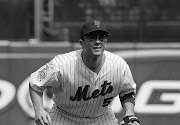
Historic Rewind: David Wright
A lot of attention was given to the season that David Wright had in 2007, and rightly so. The Mets' September collapse cost Wright the MVP award and tarnished one of the truly great seasons in baseball history.

Only four players in the history of Major League Baseball have had the combination of numbers that Wright accumulated in 2007: 40+ 2Bs, 30+ HRs, 30+ SBs, .300+ BA, .400+ OBP. The first to accomplish the feat was Ellis Burks in 1996 playing in the thin air of Colorado. Burks put together 45 doubles, 40 homers, 32 steals, a .344 average, and .408 OBP. The very next season a fellow Rocky took advantage of the rare air, with Larry Walker racking up 46 doubles, 49 homers, 33 steals, a .366 batting average, and a .452 on-base percentage. In 2004, Bobby Abreu cashed in on the limited dimensions of Citizens Bank Park totaling 47 doubles, 30 homers, 40 steals, a .301 average, and a .428 OBP.
Wright became the first player to accomplish the feat while playing his home games in a pitcher's park. Wright put together 42 doubles, 30 home runs, 34 steals, a .325 average, and a .416 OBP.
Wright stands as the only player of these four to continue to play and put up similar numbers. It remains to be seen if Wright can become the only player to ever accomplish the feat twice in his career, when the Mets move to Citi Field in 2009.

Only four players in the history of Major League Baseball have had the combination of numbers that Wright accumulated in 2007: 40+ 2Bs, 30+ HRs, 30+ SBs, .300+ BA, .400+ OBP. The first to accomplish the feat was Ellis Burks in 1996 playing in the thin air of Colorado. Burks put together 45 doubles, 40 homers, 32 steals, a .344 average, and .408 OBP. The very next season a fellow Rocky took advantage of the rare air, with Larry Walker racking up 46 doubles, 49 homers, 33 steals, a .366 batting average, and a .452 on-base percentage. In 2004, Bobby Abreu cashed in on the limited dimensions of Citizens Bank Park totaling 47 doubles, 30 homers, 40 steals, a .301 average, and a .428 OBP.
Wright became the first player to accomplish the feat while playing his home games in a pitcher's park. Wright put together 42 doubles, 30 home runs, 34 steals, a .325 average, and a .416 OBP.
Wright stands as the only player of these four to continue to play and put up similar numbers. It remains to be seen if Wright can become the only player to ever accomplish the feat twice in his career, when the Mets move to Citi Field in 2009.
Subscribe to:
Posts (Atom)